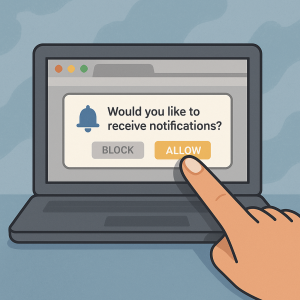
Google is cleaning up: with the new “Safety Check” in Chrome, the browser quietly starts disabling notifications that users rarely or never click on.
What sounds like a small UX adjustment has enormous implications for publishers and marketers — because web push depends directly on the browser ecosystem.
But instead of panic, what’s needed now is perspective: this update is not an attack on web push, but a signal that is making the market more mature.
📎 Offizieller Chromium-Blogpost (englisch)
The update: Chrome silently withdraws permissions
Since mid-October 2025, Google has activated a feature that automatically checks
which websites have “earned” their push notification permission.
👉If a user shows no interaction for weeks or months — meaning no clicks on notifications and no more visits to the site —
Chrome resets the push permission back to “Ask”.
💡 According to Google, the average interaction rate worldwide is below 1%.
99% of notifications are simply dismissed.
With this, Chrome aims to reduce “notification overload” and give users more control and peace.
What exactly Chrome does 🔍
The new behavior runs fully automatically through the “Safety Check” security module.
- The browser analyzes how often users click on notifications and whether they have visited the website recently.
- If interaction is below 1% or the last visit was more than 30–90 days ago, the opt-in is automatically revoked.
- Users can simply give their consent again the next time they visit.
- Active and loyal users are not affected.
Chrome limits this feature to classic websites — installed PWAs remain unaffected.
The visible effects for publishers📊
In the first weeks after the rollout, typical patterns appear:
📉 Short term:
– Decline in the total number of subscribers, since inactive users are removed.
📈 Mid term:
– Rising click-through rates (CTR), because only active readers remain in the pool.
– Higher CPMs for monetized push campaigns.
– Editorial pushes remain stable, because interested readers are not unsubscribed.
💬 Bottom line:
Chrome reduces reach, but increases the quality of the remaining audience — and that is the real opportunity.
Not a setback, but a market cleanup 🧠
You could also put it this way: Chrome is now doing technically what a good publisher should have been doing strategically all along.
📉 Will be removed:
– Price comparison portals with generic deals
– Clickbait news without real value
– Sites with too high push frequency
📈 Will benefit:
– News and special-interest portals with relevant updates
– E-commerce providers with real utility (e.g., price alerts, clearance items, pre-orders)
– Brands that treat advertising as relevant information
Because in the end it counts:
🔹 Push without relevance is noise.
🔹 Push with relevance is service.
Good advertising is also good information. 💡
Many confuse “advertising” with disturbance — but it can have real relevance.
A price alert, a seasonal sale, or a new product in a favorite category:
This is not a nuisance, but added value.
Relevant advertising is good news — when it arrives at the right time, is transparent, and matches the user’s interests.
Web push is particularly suitable for this:
- no cookie tracking,
- no login,
- no platform in between.
If the user gets, with one click, something they really want — information or inspiration —
then that is good advertising. And Chrome will make this distinction even more visible in the future.
Web push remains strategic — just smarter.
The new Chrome behaviour doesn’t change the underlying logic: Web push is and remains the only cross-platform direct channel in the browser.
But it only works with genuine relevance.
Das neue Chrome-Verhalten ändert nichts an der Grundlogik: Webpush ist und bleibt der einzige plattformübergreifende Direktkanal im Browser.
Aber: Er funktioniert nur mit echter Relevanz.
Relevance means:
📰 News publishers: Push notifications only when they carry real significance or breaking news.
🛍️ E-commerce: Price alerts, back-in-stock messages, flash sales.
💰 Advertising: Native ads with real value instead of generic clickbait.
In the future, every push permission will be earned – not granted.
The bigger context: browser ecosystem instead of monopoly
Web push is not a proprietary Google feature, but an open W3C standard.
Firefox, Edge, Opera, and Safari (macOS) also support it — partly with their own privacy policies.
What Google is doing now is not abolishment, but education: more quality, less nuisance.
A step that will improve the perception of the channel in the long term.
Conclusion: Chrome protects users — and strengthens good publishers.🧭
The “Safety Check” is not an attack on web push, but an update against lack of relevance. This is inconvenient for those who misuse push notifications as a traffic machine.
But it is an advantage for those who provide real value to their readers — editorially, commercially, or in a hybrid form.
🔹 Good publishers are rewarded.
🔹 Poor push practices are filtered out.
🔹 User trust is strengthened.
Or, in one sentence: Chrome is cleaning up — and making room for quality.
Recommendations for action 💡
✅ Check relevance: Every push needs clear added value (news, service, deal).✅ Measure engagement: Regularly analyze CTRs, clean up inactive segments.
✅ Reduce frequency: Fewer, but more relevant pushes.
✅ Think hybrid: Editorial + native ads as added value, not as opposites.
✅ Stay technically clean: HTTPS, keep service workers up to date, clear opt-out option.
Autor: Ulf Heyden