The battle for visibility on the internet has changed dramatically. While Google, Facebook, and now AI-driven feeds control the flow of traffic, publishers are losing direct contact with their readers.
A subtle yet powerful lever is coming into focus: Webpush🔔.
Browser-based push notifications — long a standard in e-commerce — will become a strategic asset for media companies in 2025. Those who use them wisely can build their own GDPR-compliant reach, independent of search engines, social media, or apps.
👉 This article explains why Webpush is not a technical nice-to-have, but a key to digital sovereignty for publishers.
1. The lost connection: When reach is controlled by others
Dependency on platforms is greater than ever. Google filters, Meta prioritizes, and AI models paraphrase. But they all have one thing in common: they own the access to the user — not the publisher.
This leads to three structural problems:
🚫 Reach on loan: Visibility depends on algorithms.
🕳️ No data sovereignty: A black box sits between the user and the editorial team.
💔 Declining loyalty: Readers click, but they “belong” to no one.
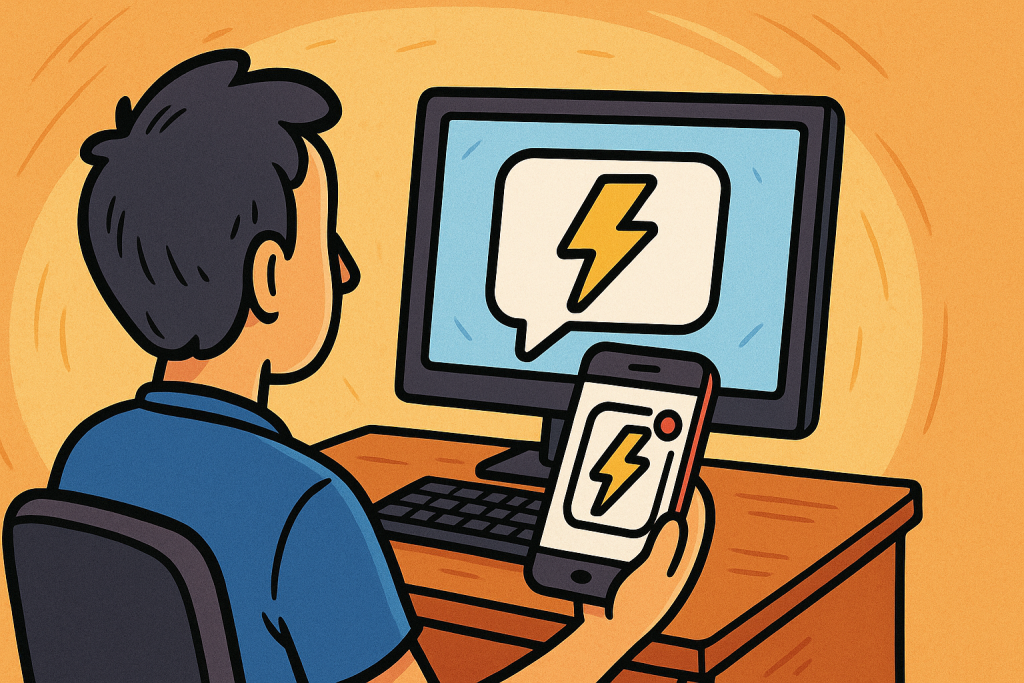
This is where Webpush comes in. The technology makes it possible to deliver messages directly to users’ screens — without an app, without email, and without cookies.
Once they’ve opted in (“Allow”), the reader remains reachable — even after leaving the website. This is exactly where the game-changer lies.⚡
2. What is Webpush — and how does it work?
Webpush is a standard natively supported by browsers like Chrome, Firefox, Edge, and Safari (on macOS).
-
The website asks the visitor for permission to send notifications.
-
If they agree, a small ID is stored in the browser.
-
Through this “Service Worker,” messages can be delivered — even when the user is on another site.
📈 The result: A direct, immediately visible communication channel that outperforms emails in terms of open rates by a large margin.
👉 CTR rates between 1% and 12% are realistic.
3. Why publishers have been using Webpush incorrectly until now
In Germany, Webpush is mostly used defensively — as a CRM tool for in-house newsletters, subscription notices, or breaking news alerts.
That makes sense, but it leaves enormous potential untapped.
Because internationally, Webpush has long since established itself as a monetization channel.💰
Providers like Adrenalead in France or iZooto in India show that push notifications can be programmatically filled with native advertising.
This creates campaigns with clear value generation:
🧩 Own content + partner offers = hybrid push inventory
💸 Revenue share instead of license fees
🛡️ No adblock issues
While German providers like Cleverpush or Braze usually only enable “self-promotion,” systems like Adrenalead combine push CRM with programmatic native ads — a mix that can generate advertising revenues of several hundred to several thousand euros per month, even with medium-sized reach.
4. The psychological advantage: Relevance beats reach
Push notifications are short, clear, and present.
They appear exactly where attention happens — in the notification bar.📱
This has several effects:
👀 High visibility: No scrolling, no algorithm.
⚡ Immediate response: Click or close — there are no other options.
🔁 Retention effect: Users who receive regular push notifications within the first 90 days remain active long term.
In short: Webpush brings readers back — before they disappear for good in the endless stream of feeds.
5. Data protection as a competitive advantage 🛡️
Webpush is GDPR-compliant because no personal data is stored.
No name, no email, no phone number — only a technical browser key.
This means:
✅ No opt-in chaos via cookie banners
✅ No CRM integration needed
✅ No risk from third-party data
On the contrary: Publishers who integrate Webpush strengthen their first-party strategy — and free themselves from cookie dependency.
6. Monetization: From cost factor to revenue channel 💶
Classic push services charge monthly license fees.
With advertising models like Adrenalead or iZooto, the logic is reversed:
The provider pays the publisher.
Depending on reach and click-through rate, the results are:
| Key metric | Example value | Monthly revenue |
|---|---|---|
| 👥 100 000 subscribersr | CTR 4 % | approx. 500 – 1 500 € |
| 🌐 1 million monthly visits | 3 % opt-in rate | 1 000 – 3 000 € |
This turns a CRM tool into a new advertising channel — with almost zero technical effort.
7. Risks and the right dosage ⚖️
Of course: push spam kills reach.
Anyone who sends irrelevant alerts daily loses users faster than they gain them.
Rules for success:
🔹 Less is more (max. 1–2 pushes per day)
🔹 Clear separation between editorial and advertising formats
🔹 Real value instead of clickbait
💬 Rule of thumb: Every push must make the user smarter, wealthier, or more curious.
8. Strategic importance: Owned distribution instead of algorithm dependence 🚀
In the age of AI-driven feeds, Webpush is part of a larger movement:
Publishers are reclaiming direct contact with their readers.
Like newsletters, apps, or login clubs, Webpush is one of the channels that create independence.
Especially interesting: push interactions generate strong user signals — CTR, dwell time, returning visitors — thereby boosting EEAT signals for Google Discover and SEO.
👉 Push traffic is therefore not only a revenue source but also a ranking booster.
Conclusion: A direct line to the reader is possible again
Webpush is not a gimmick. It is a strategic communication channel that:
✅ Makes reach independent of platforms
✅ Enables monetization without cookie dependency
✅ Measurably strengthens reader engagement
✅ Improves SEO and Discover signals
Publishers who in 2025 rely solely on Google and social media risk digital invisibility.
Those who integrate Webpush — both editorially and commercially — regain a piece of their long-lost sovereignty. 💪
Recommendations 💡
1️⃣ Start testing: Integrate Webpush for 5–10% of visits — measure CTR and opt-in rate.
2️⃣ Think hybrid: Combine editorial alerts with native ad formats.
3️⃣ Leverage GDPR: No cookies needed — communication goes directly through browser consent.
4️⃣ Control frequency: 1 push = 1 valuable message.
5️⃣ Measure success: CTR, retention, revenue, Discover traffic.
Autor: Ulf Heyden
Interested in a discussion about monetization or the future of publishing?
I advise publishers on securing their monetization and repositioning themselves in the new world of AI.