We all know push notifications – from smartphones, price alerts, or breaking-news apps. But while app push has long been a standard, web push is still largely unused by many publishers.
The technology is already fully mature: it reaches millions of browser users directly, without login and without an app — with delivery rates that newsletters and social media can only dream of.💥
👉 Time to rediscover the “forgotten channel” — as a strategic owned-media asset for 2025.
1. Origin: From an App Feature to an Open Web Standard
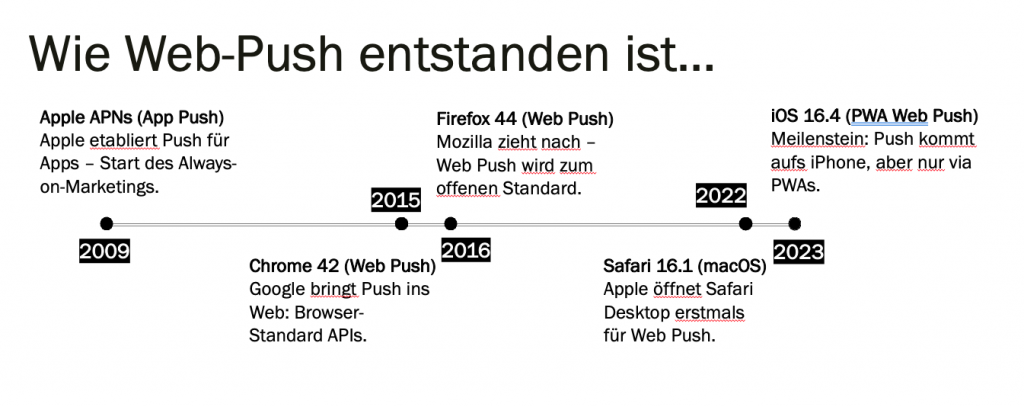
The story begins in 2015: Google expanded the Push API to the browser with Chrome.
For the first time, it became possible for websites—just like apps—to send messages directly to desktops or smartphones.
Mozilla, Microsoft, and Apple soon followed. Today, Webpush is available on almost all platforms.
Only Apple held back for a long time, but opened Safari (macOS) in 2023 and has been experimenting with PWA-based pushes since iOS 16.
💡The result: Today, web push is a globally supported communication standard — and for publishers, it is no longer a technical experiment, but everyday practice.
2. Market overview: Which browsers support web push?
To help you estimate where your pushes will reach, this overview shows the current support by browser and device:
🧩 Market overview — Browser/OS support
| Browser/OS | Push API | Notifications API | Service Worker | Desktop | Mobile |
|---|---|---|---|---|---|
| Chrome | ✅ | ✅ | ✅ | ✅ | ✅ |
| Firefox | ✅ | ✅ | ✅ | ✅ | ✅ |
| Edge | ✅ | ✅ | ✅ | ✅ | ✅ |
| Safari (macOS) | ✅ | ✅ | ✅ | ✅ | ❌ |
| Safari iOS (PWA) | ✅ | ✅ | ✅ | ❌ | ✔ (nur PWA) |
📊 Conclusion: Android and the Google ecosystem are clearly the main drivers today — but Apple is slowly catching up. Those who start now can reach over 80% of relevant browser users.
3. Distinction: Web push vs. App push vs. Newsletter 📩
Many publishers ask: “Isn’t web push just a poor man’s app push?”
No — web push is the universal, browser-based sibling that works without the user having to install
An app or be logged in.
| Channel | Requirement | Reach | Interaction | Data protection |
|---|---|---|---|---|
| 📱 App-Push | App-Installation + Login | limited | high | personalized |
| 💌 Newsletter | E-Mail-Adresse + Double-Opt-inmedium | medium | moderate | personalized |
| 🌐 Webpush | A click on “Allow” | hoch (browserweit) | strong | anonymous & GDPR-compliant |
💬In short: Web push closes the gap between newsletter (CRM) and app (retention) — fast, anonymous, effective.
4. How and when web push is delivered
Many publishers believe web push only works when their site is open.
Wrong. 😎 Here are the actual states in which a user receives pushes:
🕓 When is web push delivered?
| User state | Is the browser service active? | Notification possible? | Note / Remark |
|---|---|---|---|
| Website offen | ✅ | ✅ | Directly visible in the browser or notification center |
| Website closed, browser open | ✅ | ✅ | Standard case — push is displayed as a notification |
| Browser closed, device on | ⚠️ | ✅ (depends on the browser) | Chrome/Edge/Firefox keep the background service active |
| Device offline | ❌ | ❌ | Push is delivered on the next connection (depending on TTL) |
| Device off / sleep mode | ❌ | ❌ | Delivery paused until the device becomes active again |
🔸Important:
Web push works even without the website being open — the browser service keeps the channel active as long as the device is online.
This makes web push permanently available without having to store user data.
5. Why web push is not a gimmick — but provides 100% delivery rate
Newsletters end up in spam.
Social posts disappear in the feed.
Web push, on the other hand, always lands where attention is guaranteed — in the notification center or directly at the screen edge.
💡 Typical performance metrics:
- Delivery rate: 100%
- CTR: 5–25% (depending on segment & timing)
- Opt-in rate: 3–10% of website visitors
And the best part: No ad blocker can block pushes, because they are delivered by the browser itself.
6. Overview of benefits for publishers
🧭 Strategic: Direct communication channel to the reader
🔒 GDPR-compliant: No cookies, no login, no tracking required
📈 Efficient: More clicks per notification than newsletter open rates
💰 Monetizable: Can be used hybrid for editorial content and native ads
🚫 Independent: No dependency on platforms or algorithms
7. Status 2025: Increasing reach, dwindling excuses
With iOS support via PWAs and strong desktop traffic, web push is technically and economically ready for the mass market. Publishers who start now secure the early advantage — especially if they build their own segments.
2025 will be the year when web push makes the leap from “nice to have” to “must have.”🚀
Fazit: Webpush ist der direkte, anonyme Draht zum Leser
Webpush is not a toy for marketing departments, but an owned-media tool that combines reach, loyalty, and monetization.
✅ No spam, no adblock, no login
✅ 100% delivery rate on desktop & Android
✅ Full control over the communication channel
👉 Those who hesitate now leave the direct connection to their own readers to others.
Recommendations for action 💡
1️⃣ Start: Implement a clean opt-in flow, e.g., with Adrenalead, iZooto, or Cleverpush2️⃣ Segment: Test category- or topic-based pushes
3️⃣ Analyze: Measure CTR & retention after 30/60/90 days
4️⃣ Expand: Integrate native ads into pushes – secure additional revenue
5️⃣ Automate: Connect CMS and push system (Feed → Push → Analysis)
Autor: Ulf Heyden